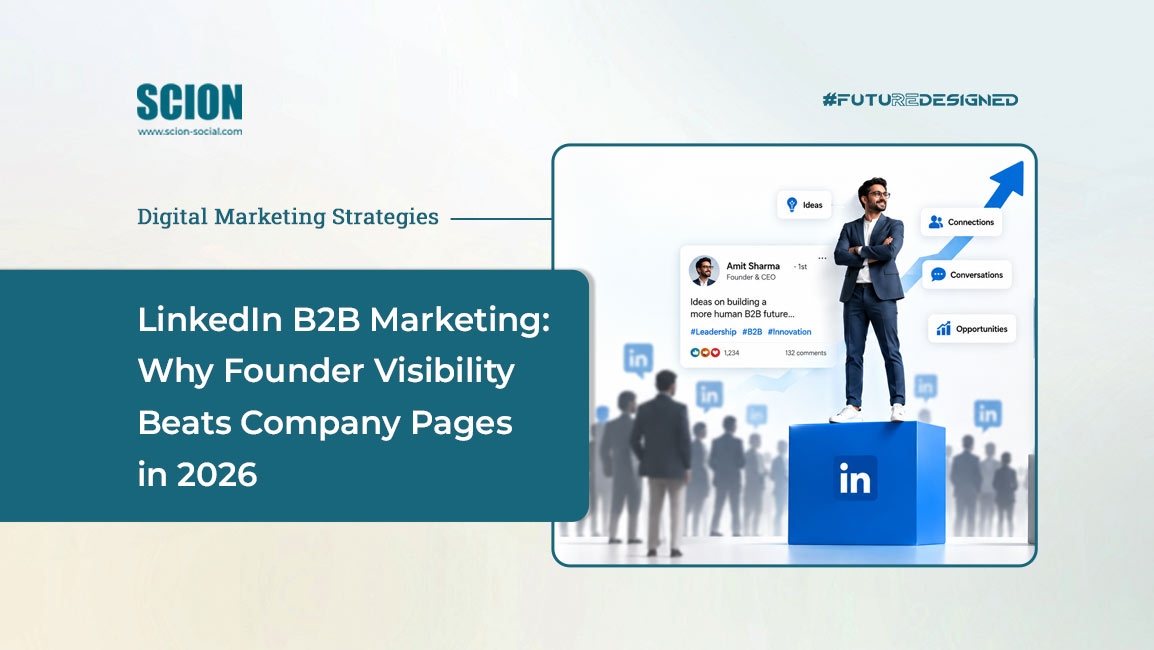


Your company posts on LinkedIn. Your founder posts on LinkedIn.
One of them is far more likely to get people talking.
That’s where the real opportunity in LinkedIn B2B marketing lies in 2026. Company pages still matter, but founders and senior leaders have something a logo can’t replicate: a personal voice people can recognize, respond to, and remember.
And that changes how businesses should approach the platform.
This isn’t another list of LinkedIn post ideas or a reminder to “post consistently.” We’ll show you how to build a working content funnel around a founder profile – where every post has a job to do and visibility has somewhere to lead.
Why People Are Your Biggest Advantage on LinkedIn
Is LinkedIn good for B2B marketing? Absolutely. But there’s a big difference between being present and being noticed.
For LinkedIn for B2B sales, familiarity matters. A buyer might encounter your founder’s insight, see them contributing to a conversation, and return for another post before they ever visit your website. Those repeated touchpoints make the person – and the business behind them – familiar.
And the numbers make the opportunity hard to ignore.
Metricool’s 2026 LinkedIn Study analyzed 673,658 posts from 63,108 accounts worldwide. Personal profiles achieved an average engagement rate of 2.60%, compared with 1.60% for company pages. That’s a 63% advantage.
That’s not an argument for abandoning your LinkedIn business page, but it is an argument for giving it the right job. The page supports the business. The profile gives people a reason to engage with it.
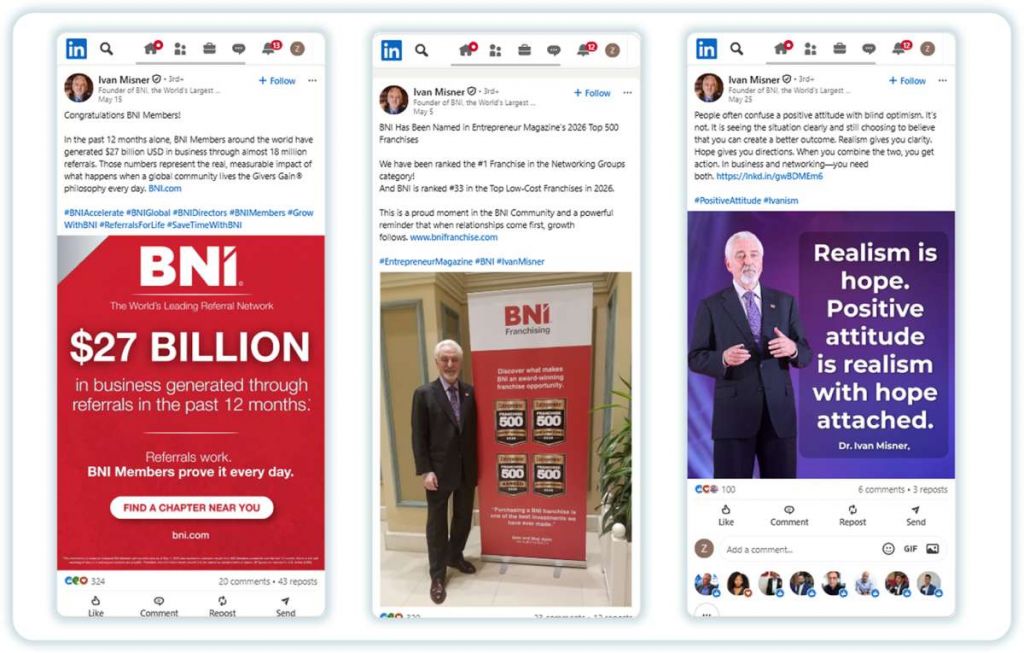
Scion’s profile-led work with BNI founder Ivan Misner puts that into perspective.
From Aug 2025 to February 2026, his personal LinkedIn profile achieved 5% content engagement compared to 3.9% in January to July 2025 on the business page. The significance is the number of people actively choosing to follow Ivan’s ideas, engage with them, and carry them into their own networks.
Your founder doesn’t need to become an influencer. They need to become a recognizable voice for the knowledge and perspective that already make your business worth paying attention to.
And if you want to strengthen that presence before building your content strategy, our guide to LinkedIn personal branding shows you where to start.
Your Profile Is a Landing Page, Not a Resume
Every post that catches someone’s attention creates a moment of curiosity. Who is this person? What do they actually do? Could they help me?
Your profile needs to answer those questions quickly.
That’s why effective LinkedIn personal branding means treating your profile less like a resume and more like a landing page. A resume looks backwards at what you’ve done. Your LinkedIn profile should make it immediately clear who you help, what you help them achieve, and why you’re worth listening to.
Think of your content as the reason someone arrives and your profile as the reason they stay. It should turn passing interest into a follow, a conversation, a website visit, or another meaningful next step.
Later, we’ll break down exactly what that looks like – from your profile photo and headline to your About and Featured sections. For now, the principle is simple: don’t make people work to understand why you’re relevant.
The Founder Content Funnel
Knowing what to post on LinkedIn is only half the challenge. The more important question is: what purpose does each post serve?
A strong LinkedIn B2B marketing strategy doesn’t treat every post the same. Some establish credibility. Others give people a reason to follow you, challenge the way they think, or encourage them to take action.
That’s where the Founder Content Funnel comes in. Instead of chasing an endless supply of LinkedIn post ideas, build your content around four distinct jobs.
1 Curiosity: Stop Them Mid-Scroll
This is where LinkedIn thought leadership actually earns its name.
Challenge an accepted idea. Share a surprising piece of data. Explain the thinking behind a decision others in your industry might question. The aim isn’t controversy for clicks. It’s to give people something worth thinking about.
Example: “We stopped measuring our sales team’s success by the number of meetings booked. Here’s what we measure instead.”
A strong point of view gives people something to respond to and something to remember you by.
2. Benefit: Make Your Expertise Useful
Give people something they can use, whether they ever become a customer or not.
Share a lesson you’ve learned, a mistake they can avoid, a practical process, or one change they could make today. They should leave knowing something new – or knowing what to do differently.
Example: Instead of posting “Five ways we help clients improve sales,” share the sales question your team stopped asking – and the one you use instead to uncover what a prospect actually needs.
Give people enough value and they’ll have a reason to keep following.
3. Proof: Show, Don’t Tell
Before you ask someone to buy, book, register, or even take your advice seriously, give them a reason to trust you.
Share client results, testimonials, business milestones, referral wins, awards, or tangible outcomes that turn your claims into evidence.
Example: A founder could share how a client increased qualified leads by 40%, explain the problem they started with, and reveal the one change that made the biggest difference.
You’re not saying, “We’re great at what we do.” You’re showing it.
4. Offer: Make the Ask
If you’re using LinkedIn for B2B sales, content should eventually create opportunities. This is where you turn attention into action.
Book a call. Register for an event. Download a resource. Join a program. Enquire about a service. Whatever the next step is, say it clearly.
Proof, Benefit, and Curiosity have already built credibility and interest, so there’s no need to disguise the ask.
Example: “We’re opening five places for our October workshop. If you want to build a LinkedIn strategy that generates conversations rather than just impressions, here’s what you’ll learn and how to join.”
Offer less often than you educate, prove, or provoke. But when you do, be direct.
How Often Should You Post on LinkedIn?
Forget the pressure to post every day. Three strong posts a week will do more for your reputation than seven posts written simply to hit a quota.
Build gradually towards three to five posts a week and focus on a rhythm you can sustain. Consistency compounds; bursts of activity don’t.
Format matters, too. Text-led stories and native carousels can work particularly well for B2B founder content, but the idea should always come first. Choose the format that serves it.
Plus, remember that founder-led doesn’t have to mean founder-only. You can bring in team expertise, shared wins, and the people behind the results.
Need fresh ideas? Scion’s Content Ideas Cheat Sheet gives you ready-to-use prompts for turning your expertise into posts with a purpose.
What a Month of Founder Content Actually Looks Like
It shouldn’t feel like 20 variations of the same post. If you’re not sure what to post on LinkedIn, mapping your LinkedIn post ideas makes it much easier to spot what you’re overusing and what’s missing altogether.
So, Does the Company Page Still Matter?
Yes. It just has a different job to do. Think of the split like this:
- The profile carries the point of view
- The page carries the evidence
Your LinkedIn business page is where prospects validate what they’ve learned about you and where company news, case studies, milestones, and other proof have a permanent home. It keeps your brand active and credible – but doesn’t expect it to do all the heavy lifting.
If you’re starting from scratch, head to our guide on how to create a LinkedIn business page for the steps to get yours up and running.
So, if the company page provides the proof, what carries the conversation forward? For BNI Directors, your profile is often the first place someone goes after discovering you, your chapter, or your work. It gives people a chance to understand who you are, what you do, and why they should connect with you.
That means the next step isn’t to abandon your company page. It’s to make sure your personal profile is ready to do its part.
For BNI Directors: A Step-by-Step LinkedIn Profile Walkthrough
Your chapter already knows who you are. Your profile is for everyone who finds you beyond it.
Strong LinkedIn personal branding means making it immediately clear what you do, who you help, and what makes your expertise relevant to them.
Here’s what matters, in seven simple steps.
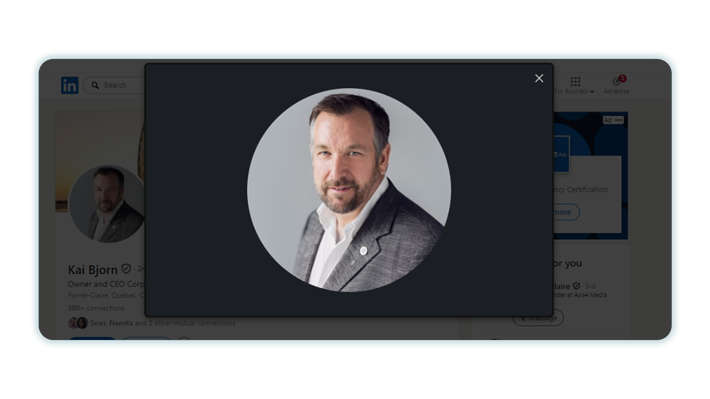
Step 1: Make Your Profile Photo Recognizable
Your photo should look like you now, not you five years ago.
Choose a current, well-lit image with an uncluttered background and your face filling most of the frame. Keep it professional, but recognizably you – the same person a member would introduce at a meeting.
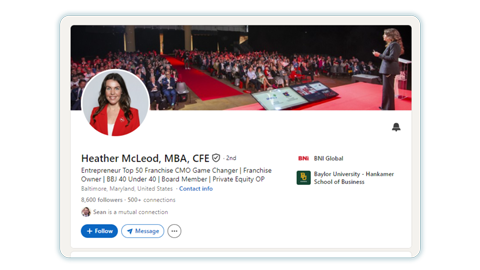
Step 2: Don’t Waste Your Cover Image
The space behind your profile photo is valuable real estate, yet it’s one of the most underused parts of a LinkedIn profile.
Use it to show your region or chapter, a speaking moment, or a clean branded banner that says what you do and who you serve. Before someone starts scrolling, you’ve already given them another reason to understand what you’re about.
Step 3: Make Your Headline Work Harder
Your headline follows you around LinkedIn. It appears beside your name wherever you show up, and plenty of people will read it without ever visiting your profile.
So don’t stop at your job title:
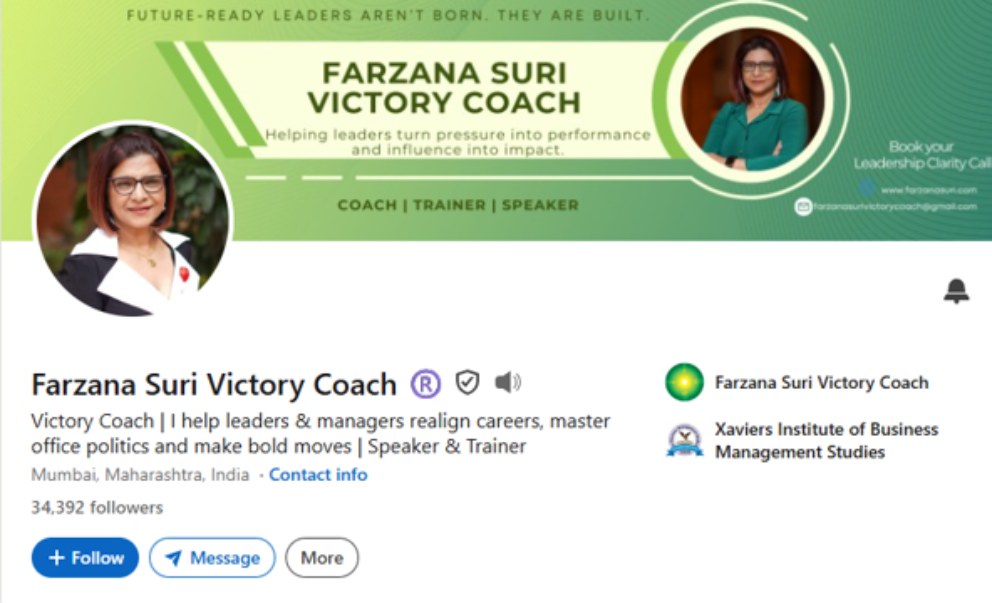
The formula is simple: your role + who you help + the value you bring.
Step 4: Make Your About Section About Them
Instead of opening with your career history, open with the problem you help solve.
For a BNI Director, that might mean explaining what you help members achieve, the businesses you’ve helped grow, and how someone can start a conversation with you.
Write in the first person and keep your paragraphs short. LinkedIn truncates the About section after the opening lines, so don’t bury the reason to keep reading.
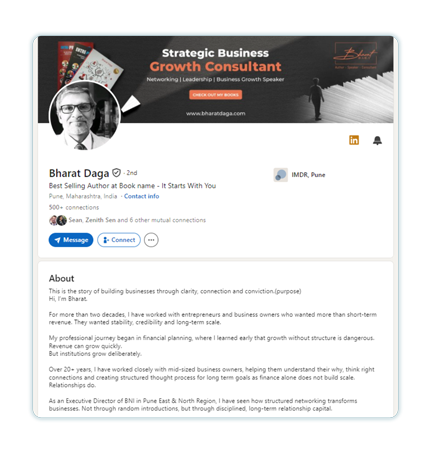
Bharat Daga’s profile is a useful example. His About section centers on his work, ideas, and books rather than reading like a conventional resume summary.
Step 5: Put Your Best Proof Up Front
Don’t make people dig through your profile to find evidence of what you can do. That’s what your Featured section is for.
Choose two or three pieces that reinforce what you want to be known for. That could be a referral success story, an award or media mention, or a post that demonstrates your expertise particularly well.
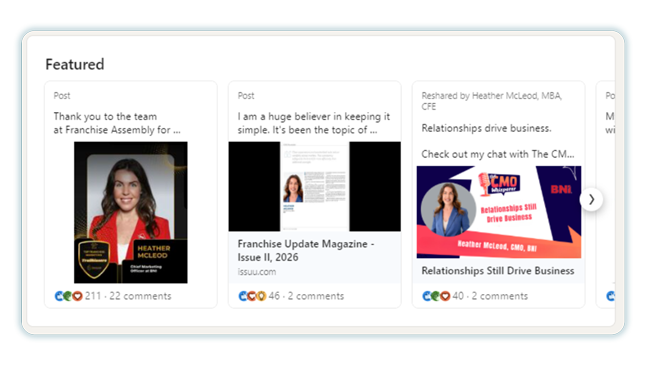
Heather McLeod’s profile shows how this can work, bringing wins and coverage into view without making someone search for them.
Step 6: Post for the Network Beyond Your Network
Referral wins, member spotlights, chapter milestones, and your own expertise all belong on your profile. The trick is to tell those stories in a way that means something to people outside BNI too.
Use the same Founder Content Funnel we covered earlier – Curiosity, Benefit, Proof, and Offer – to vary the role those posts play. And remember: consistent beats frequent.
Step 7: Spot the Signals
Hitting publish isn’t the end of the job. Comment on members’ posts, contribute to their conversations, and pay close attention to who starts appearing around your content. A recurring commenter, a profile view after a post, or a referral partner who keeps engaging – those are signals worth following.
And when there’s a reason to continue the conversation, do it. A direct, personal follow-up is where engagement becomes a genuine B2B opportunity.
Want to make sure promising conversations don’t slip through the cracks? Scion’s LinkedIn Automation Tools can help make that follow-up easy and repeatable.
Put all seven steps together and your profile becomes more than somewhere people can look you up. It extends your credibility far beyond the weekly meeting.
Making the Shift Without Starting Over
You don’t need to tear up your LinkedIn strategy and start again. But you do need to redistribute the work.
Keep the LinkedIn business page focused on the company. Move insights, opinions, lessons, and conversations to the people best placed to own them.
And try to resist the copy-and-paste approach. A founder reposting the company update word for word isn’t founder-led marketing – it’s simply giving the same post a different profile picture. If the same story belongs on both, change the angle. What does your founder know about it that the company page can’t say?
You may see the first signs within weeks: more profile views, connection requests, comments, and familiar names returning to your content. The bigger gains come from staying visible long enough for that recognition to compound over months.

Ready to Turn LinkedIn Into a Growth Engine for Your BNI Market?
Stay visible, professional, and consistent with a done-for-you LinkedIn solution built specifically for BNI Leaders.

Put Your Best Voices Forward
Great expertise deserves to be heard. LinkedIn lets you bring it directly into the conversation.
That’s the real opportunity: not more content for the sake of being visible, but the thinking, perspective, and personality that makes your business worth knowing.
So, start with three things:
- Look at where your strongest ideas are currently being shared.
- Give your founder a platform to own the point of view.
- Let the company page back it up with the proof.
You already have the expertise. The smartest LinkedIn B2B marketing simply puts a face – and a voice – to it.
Publishing consistently matters, but posting is only one part of a strong LinkedIn rhythm. The real value comes from what happens around each post: the conversations you start, the signals you notice, and the follow-ups you make while interest is still warm.
Build a LinkedIn Rhythm That Goes Beyond Posting
- Share useful content at a sustainable pace. Aim for three to five strong posts a week, rotating between Curiosity , Benefit, Proof, and Offer so your content has a clear purpose.
- Engage before and after you publish. Comment on relevant posts, respond to replies, and add thoughtful perspective where your audience is already paying attention.
- Watch for intent signals. Repeat commenters, post-driven profile views, new connection requests, and familiar names returning to your content are all signs worth tracking.
- Follow up with context. When someone shows genuine interest, continue the conversation with a specific, personal message instead of a generic sales pitch.
Your Profile Is Ready. Now Put It to Work.
An optimized profile is only the beginning. What you do with it next is what matters.
* Post with purpose : Put the content calendar we’ve shared above to work. Think member wins, interviews, your own insights, and relevant content from BNI Global – with your take added in.
* Get into the conversation : Engage with your members’ posts and the wider conversations happening across your network.
* Build the network you want : Connect with people in the professions you’re looking to bring into BNI and start building those relationships.
* Make the invitation count : When you have a Visitors Day coming up or spots you’re looking to fill, give the right people a clear reason to join you.
A strong profile gets you noticed. An active one builds your network.
FAQ’s
Yes. LinkedIn gives B2B businesses direct access to decision-makers, potential clients, partners, and professional networks. The key is to use it as more than a company broadcast channel, with founders and senior leaders actively contributing their own expertise and perspective.
Company pages have fewer opportunities to create the person-to-person interactions that drive conversation on LinkedIn. Personal profiles can post, comment, respond, and build recognition around an individual voice, giving people more ways to encounter and engage with them.
Build your content around a clear purpose. Use Proof to demonstrate results, Benefit to share useful expertise, Curiosity to introduce a point of view, and Offer when you want people to take action.
Aim for three to five strong posts a week rather than posting simply to fill a daily quota. Start with a frequency you can maintain and build from there.
Yes, but they work best when given the right role. Use your company page as a credible home for business updates, case studies, milestones, hiring, and proof, while personal profiles lead more of the conversation.
Use both. Your personal profile gives your expertise and point of view a recognizable voice, while your company page provides the evidence and business presence behind it.