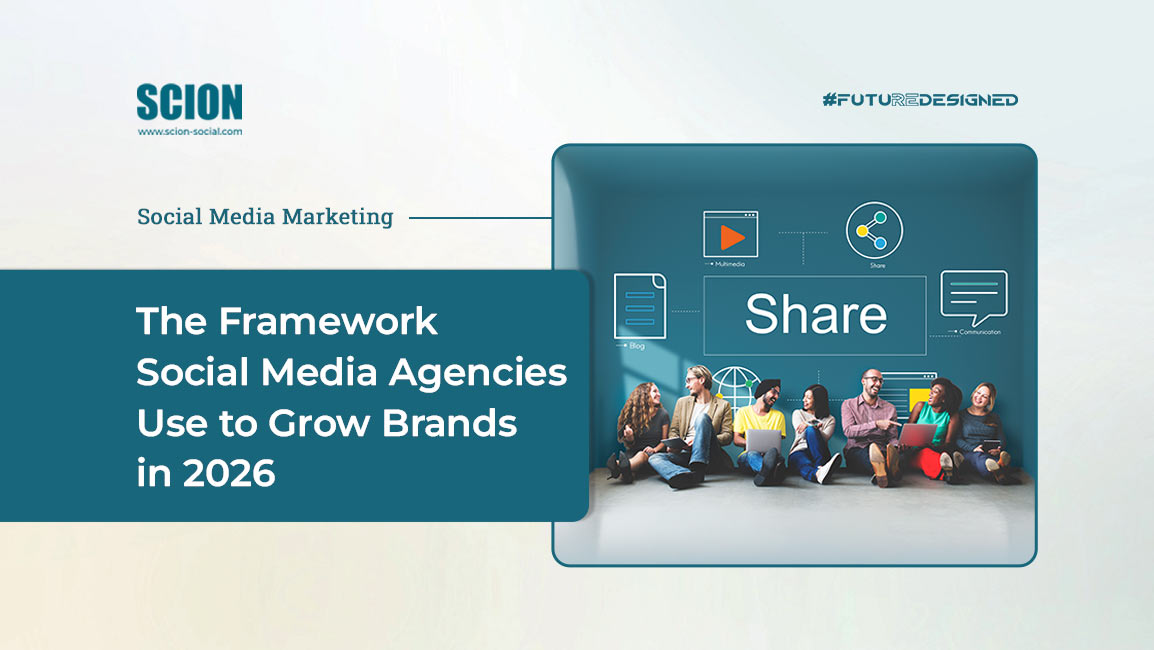

Social media is one of the most powerful brand-building tools available to businesses today. But not every brand is getting the same results. And the truth is, there’s a reason behind that.
You may be creating content, posting consistently, jumping on trends, and tracking your metrics, but you still can’t figure it out. Why isn’t social media working for you? Is something missing?
Yes, something is missing.
The difference between brands that grow and brands that simply post almost always comes down to one thing: structure. A framework that ties every post, format, and platform back to a real business goal.
This is exactly what a high-performing social media marketing agency builds before a single piece of content is created. And it’s why brands that are serious about growth aren’t leaving social media to chance.
A bold social media agency doesn’t just manage or schedule posts. It brings everything together – positioning, messaging, platforms, content, paid amplification, and measurement – and takes responsibility for turning social presence into tangible business results.
This article breaks down how social media marketing agencies are accomplishing that in 2026, and why brands that treat social as a growth system are seeing significantly stronger results.
What Does a Social Media Agency Actually Do?
There’s a common misconception that hiring a social media agency means outsourcing your Instagram. The reality is far more strategic than that.
A social media agency is responsible for the full architecture of a brand’s social presence: how it shows up, what it says, who it reaches, and how that reach converts into real commercial outcomes.
The scope has also evolved. Agencies no longer just schedule content. They manage a brand’s entire social ecosystem: organic content, paid campaigns, community engagement, and measurement. All of it connected. All of it deliberate.
Core Social Media Agency Services
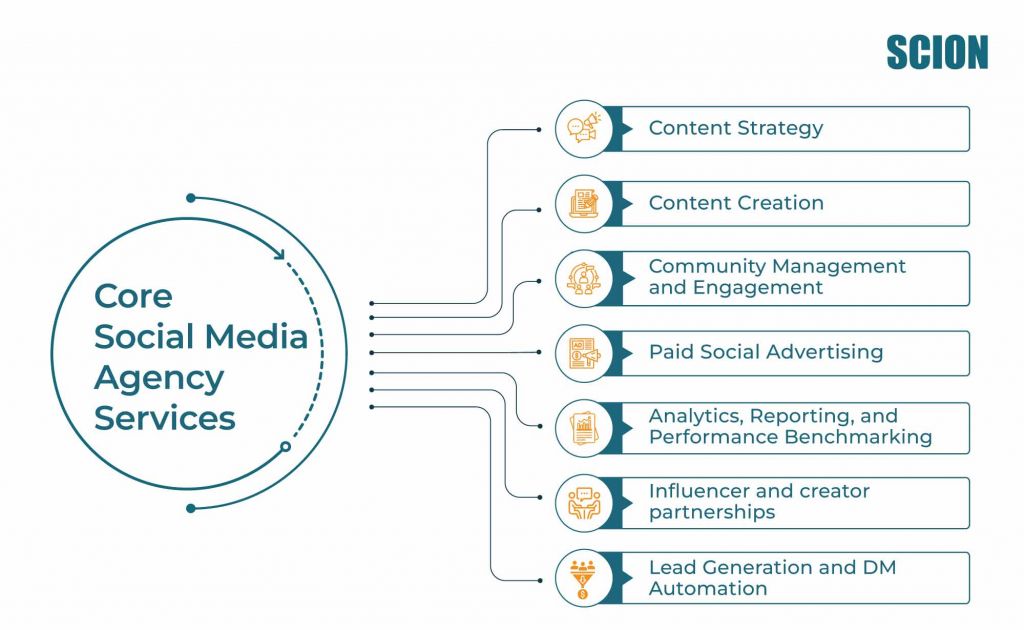
Modern social media agency services don’t stop at lead generation. They support the entire customer journey; from first discovery to enquiry, and ongoing engagement with customers who then become advocates for the brand.
The goal isn’t just awareness, and it isn’t just leads. It’s creating a full-funnel social media campaign where content builds trust, trust drives action, and existing customers strengthen your message through community, engagement, and sharing.
In 2026, an effective social media management agency connects a content calendar directly to revenue, retention, and long-term brand growth.
This includes:
- Content strategy: Defining what the brand needs to say, who it needs to say it to, what pain points it addresses, which messages matter most, and which formats and platforms are right for delivering that message.
- Content creation: Turning that strategy into short-form video, carousels, thought leadership, and platform-native formats that achieve specific objectives at every stage.
- Community management and engagement: Responding to comments, managing DMs, and building genuine audience relationships that pay off over time.
- Paid social advertising: Full-funnel campaigns across LinkedIn, Meta, Instagram, and YouTube, built around brand and performance objectives.
- Analytics, reporting, and performance benchmarking: Tracking what moves the needle, not just what looks good in a screenshot.
- Influencer and creator partnerships: Identifying and activating the voices your audience already trusts.
- Lead generation and DM automation: Using marketing automation and lead generation tools like ManyChat to convert social followers directly into the pipeline through DM conversations.

Social Media for BNI Markets. Sorted.
Everything you need to run your social media: ready-to-use content, tools, templates, and support. Delivered monthly.

The 2026 Social Media Framework: How Agencies Build Brand Presence
The most effective social media marketing agencies work from a framework – a four-stage system that connects every piece of content to a specific goal. Here’s how it operates.
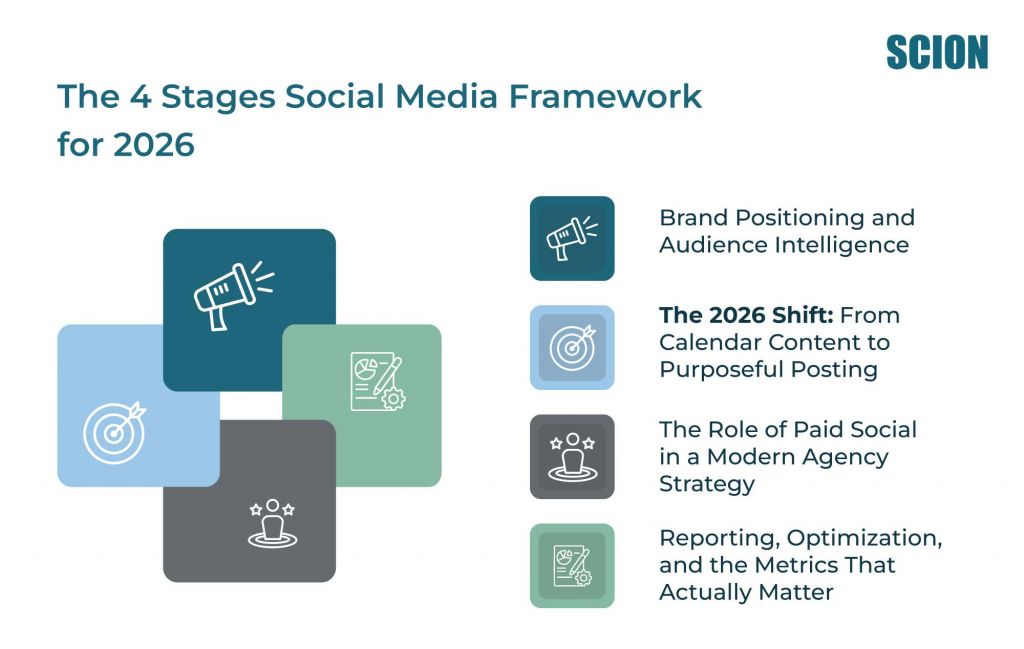
Stage 1: Brand Positioning and Audience Intelligence
Everything starts before a single post is written. Before platform selection, before content formats, before a penny of ad spend – a serious social media agency does the strategic groundwork that most brands skip entirely.
At Scion, this stage is built on one non-negotiable principle: every piece of social work starts with a digital marketing strategy built around your business goals. Not a platform, not a format, not a trend.
This includes:
- ICP mapping: Defining your Ideal Customer Profile (ICP) in real depth: who the audience is, what they care about, where they spend their time, and the language they use when talking about the problems that need solving.
- Competitive social audits: Understanding the landscape your brand is entering – what competitors are doing well and where the gaps are that smart content can own.
- Platform selection: LinkedIn for B2B social media marketing, Instagram and Meta for consumer engagement, and YouTube for authority content that prompts social discovery and AI-driven search visibility.
- Voice, tone, and messaging architecture: The strategic layer that makes every post sound recognizably like you.
- Objective alignment: Translating goals into specific targets: brand awareness, lead generation, community growth, or premium positioning.
- KPI framing: Establishing upfront whether success looks like reach, engagement quality, brand search lift, or cost per qualified lead, so there’s clarity when it’s time to report.
Stage 2: The 2026 Shift: From Calendar Content to Purposeful Posting
The brands winning on social in 2026 aren’t producing the most content. They’re producing the right content, mapped to a deliberate funnel.
While many brands are still asking, “What should we post this week?”
Others have already made the shift to, “What are we trying to achieve, and what content moves people to the next step?”
A well-built social media content strategy assigns every piece of content a role in the buying journey. Top-of-funnel builds the audience. Middle-of-funnel deepens trust. Bottom-of-funnel drives action. When all three run together, social starts producing results.
Short-form video delivers the highest ROI among all video formats, and social platforms like YouTube, TikTok, and Instagram now collectively drive over 60% of product discovery – outperforming Google on search share. Agencies that are not planning with video-first thinking are already behind.
Here’s how each funnel stage works in practice:
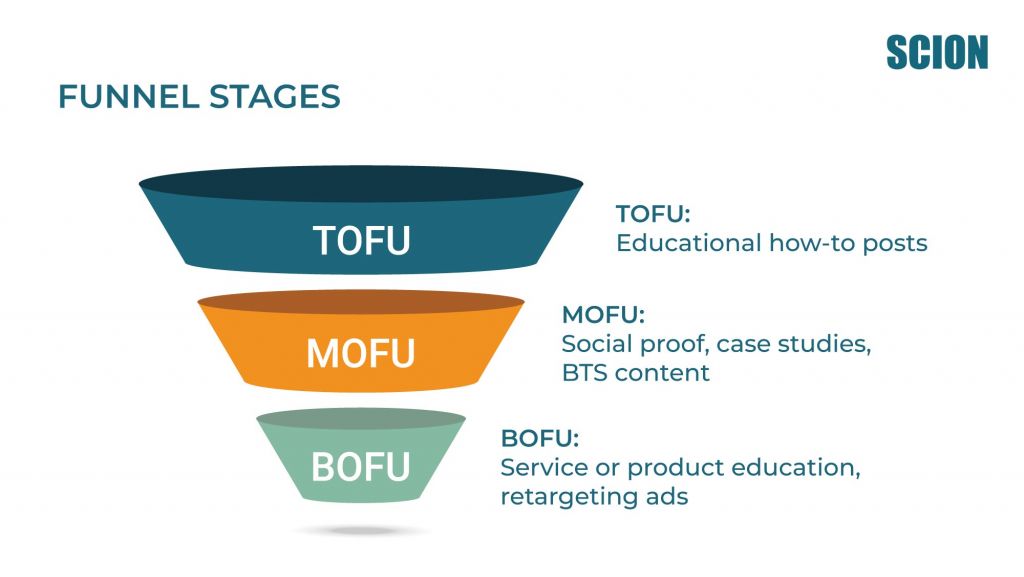
Top of funnel (TOFU): Educational how-to posts, thought leadership, short-form video, and carousels build awareness and trust with viewers who don’t yet know the brand.
Middle of funnel (MOFU): Social proof, case studies, behind-the-scenes content, and founder or team perspectives move followers from simple awareness to “This is right for me”.
Bottom of funnel (BOFU): Service or product education, retargeting ads, testimonials, and marketing automation and lead generation tools like ManyChat convert audiences into leads through DM conversations.
Carousels remain the top-performing format for educational B2B social media marketing on LinkedIn and Instagram. Reels drive the majority of organic reach for awareness-stage content.
Both matter. Neither is optional.
Stage 3: The Role of Paid Social in a Modern Agency Strategy
Organic reach has contracted. That’s not a reason to abandon organic content – but it is a reason to treat paid social as the amplification layer it was always designed to be.
The agencies delivering real results in 2026 use paid social strategically. They pay attention to which organic posts are already resonating, then use budget to scale that reach even further.
For B2B social media marketing, LinkedIn remains the highest-intent platform despite its higher cost-per-click. When campaigns are built correctly, the audience quality more than justifies the spend.
Here’s what you need to know:
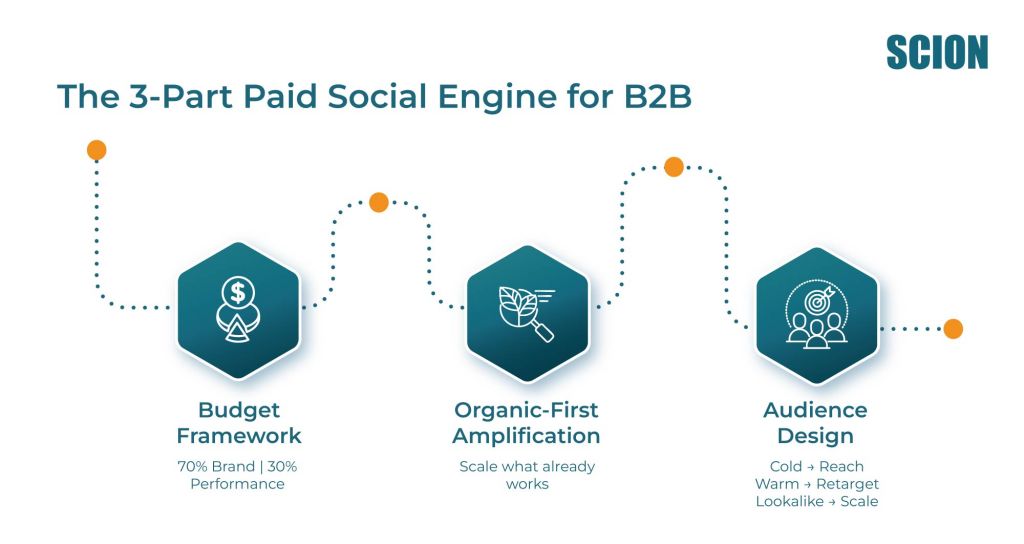
- Budget framework: A 70/30 split between brand building and performance/lead generation keeps long-term goals and short-term action moving at the same time.
- Organic-first amplification: The best-performing organic content gets scaled through paid, rather than producing separate “ad content” that lacks the authenticity audiences actually respond to.
- Audience architecture: Cold audiences for awareness, warm retargeting for nurturing, lookalike audiences for efficient prospecting.
Despite higher CPCs, LinkedIn Ads remain the strongest paid channel for reaching professional decision-makers at scale.
And for B2B brands, that reach is the point.
Stage 4: Reporting, Optimization, and the Metrics That Actually Matter
Generic social media reporting tells you what happened. Smart agency reporting shows you what to do next.
According to HubSpot’s 2026 State of Marketing Report, 61% of marketers believe the industry is experiencing its biggest disruption in 20 years due to AI. And with that disruption comes a rising demand for meaningful social performance data.
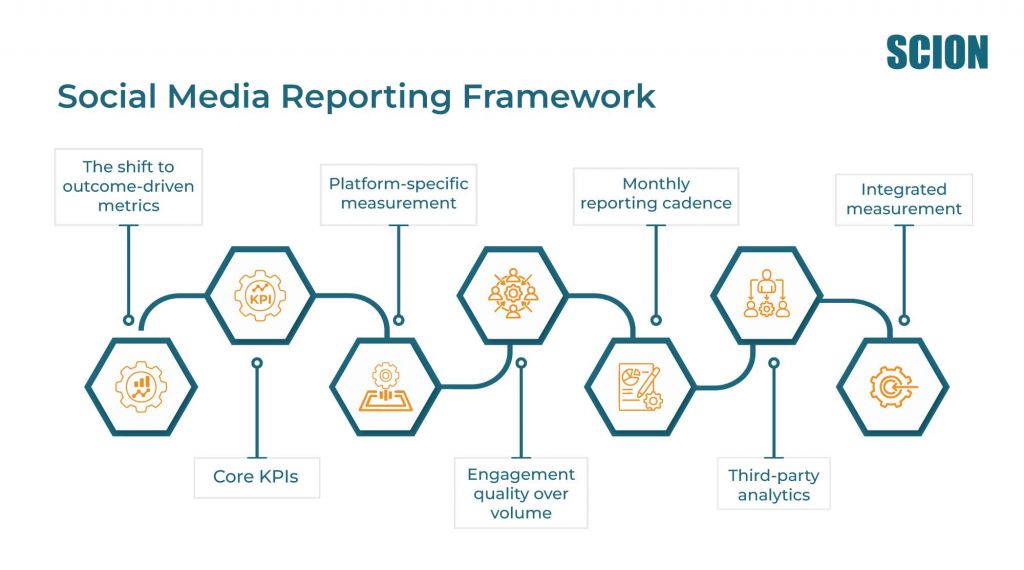
Here’s what a serious reporting framework looks like in practice:
- The shift to outcome-driven metrics: Content consumption is at an all-time high, but so is content production – and that’s what’s driving this shift. Appearing on someone’s feed is no longer enough. Every post has to earn its place by getting someone to take action – whether that’s through a save, a share, or filling out a form. Understanding how different posts serve different purposes is what separates strategic reporting from vanity reporting.
- Core KPIs: Share of voice (SOV), brand search lift, cost per qualified lead, content reach by funnel stage, and engagement rate by impression connect social activity to commercial outcomes in a way that makes sense to leadership.
- Platform-specific measurement: Each platform is measured differently because each platform serves a different purpose. Reach matters on Instagram. Intent matters on LinkedIn. Engagement quality matters on both. Applying the same metrics across every platform will give you misleading data.
- Engagement quality over volume: A post with 50 saves and 30 shares has done more work than one with 500 likes. Saves and shares show that someone found the content genuinely useful, which is what builds brand trust over time.
- Monthly reporting cadence: A structured monthly review shows what worked, why it worked, and decides what gets scaled next. Content is evaluated based on its contribution to leads, traffic, and brand growth.
- Third-party analytics: The best agencies don’t just rely on platform-native analytics. Tools like Sprout Social, Hootsuite, and Brand24 bring competitive benchmarking, sentiment tracking, and cross-channel visibility that platform dashboards alone can’t provide.
- Integrated measurement: Social, content, and SEO performance should be evaluated together – because social doesn’t exist in isolation, and neither can its reporting. The full-funnel picture reveals where growth is actually coming from.
The Evolution of Social Media in 2026: What’s Changed and Why It Matters
The rules of social media have changed significantly over the past few years. The brands and agencies that have adapted are growing. The ones still chasing follower counts are not.
From Follower Counts to Brand Ecosystem Thinking
The metrics that decided social media success in 2021 and 2022 – follower growth, like counts, reach as a primary KPI – are no longer reliable indicators of real momentum.
The modern social media marketing strategy is built around ecosystem thinking: presence across platforms, a solid narrative, and content that stops viewer scrolling in its tracks.
Measuring that influence has also gotten trickier. A big portion of how content now spreads is through dark social – someone shares your post in a WhatsApp group, a Slack channel, or a private DM.
That share never shows up in your analytics. No click is tracked. No UTM fires. But the influence is real, and it’s growing. The smartest agencies track search volume and website traffic to identify the impact social is having – even if it can’t be directly attributed.
Video and Carousel Content as Non-Negotiables
Two crucial data points point to how a social media content strategy should be built in 2026:
- Short-form video delivers the highest ROI among all video formats at 41%
- 94% of organizations say that influencer marketing outperforms traditional digital advertising
Video-first thinking is now the best approach in content planning. That doesn’t mean every post is a video. It means the content calendar is structured so that short-form video takes care of reach, while carousels and copy-led posts drive deeper engagement and consideration.
- Short-form video (Reels, YouTube Shorts): The dominant format for organic reach. Brands not producing video consistently are simply invisible to the majority of their potential audience.
- Carousels: Still the highest-engagement format for educational and thought leadership content – particularly on LinkedIn, where B2B social media marketing demands depth as much as reach.
- YouTube searchability: YouTube is the world’s second-largest search engine, so your content needs to be discoverable through search. Titles, captions, and video structure all add to how your content performs. In fact, it’s so important that we wrote a whole blog about it. Check it out here.
What does this mean practically? A credible social media agency in 2026 has in-house video production services or established creator partnerships. Because a social media content strategy without the capability to bring it to life is just a document.

Ready to Turn LinkedIn Into a Growth Engine for Your BNI Market?
Stay visible, professional, and consistent with a done-for-you LinkedIn solution built specifically for BNI Leaders.

Social Media and Broader Digital Marketing Integration
Social doesn’t sit in isolation, and the best social media marketing agencies don’t treat it like it does. A high-performing social media strategy integrates:
- SEO: Social content drives branded search volume and content discovery
- Email marketing: Social warms audiences before and after campaigns
- Paid search: Social provides the signals that improve targeting
Social media now accounts for over 60% of product discovery, even surpassing Google, which means that social content is increasingly functioning as search content, not just engagement pieces.
Brands with a strong social presence benefit from what’s known as the SEO halo effect: more people searching for them by name, more direct traffic arriving already warm, more inbound inquiries that need less convincing when they land.
Conversational marketing through Instagram and Facebook DMs, powered by tools like ManyChat, is also becoming a serious lead generation channel. Someone who would never fill in a contact form will respond to a well-timed DM. Automation makes that interaction possible at scale without losing the personal touch that makes it work.
Is Hiring a Social Media Agency Worth It? What B2B Companies Should Know
This question usually surfaces once an in-house attempt has plateaued. And the answer almost always depends on what you’re comparing it to.
The real question isn’t whether a social media agency costs money. It’s whether the alternative – a single in-house hire, a junior content manager, or no dedicated resource at all – can realistically deliver the same strategic depth, execution speed, and platform expertise.
In most cases, it can’t. And the results our clients have achieved show what’s possible when social is run as a proper growth function instead of an obligation.
Social Media for BNI Markets. Sorted.
Everything you need to run your social media: ready-to-use content, tools, templates, and support. Delivered monthly.
What You Get That an In-House Team Often Can’t Provide
A social media marketing agency brings all the necessary expertise. The strategist, the content creator, the paid media specialist, and the analyst are rarely the same person, but a good agency has all of them working on your account at the same time.
Here are just a few of the benefits:
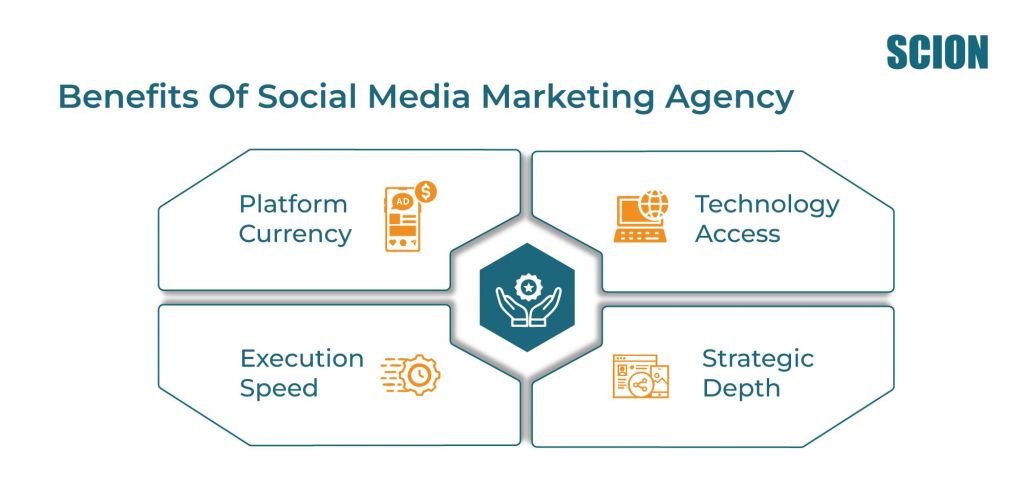
- Platform currency: Algorithms, formats, and best practices change constantly. Agencies track this as a core function.
- Execution speed: Established workflows mean content moves faster than most internal teams can manage, without sacrificing quality.
- Technology access: You get professional-grade tools – analytics platforms, scheduling software, listening tools, paid media dashboards – working for you, without the licensing costs draining your budget.
- Strategic depth: They build and run a full social media marketing strategy, instead of producing content and hoping something lands.
What to Look for When Hiring a Social Media Marketing Agency
Not all agencies are built the same. Here’s what you should look for before you sign anything:
- B2B-specific experience: B2B social media marketing takes an understanding of long sales cycles, audience behavior, and the content formats that build trust with decision-makers. Consumer agency experience doesn’t automatically translate, and the difference shows quickly.
- Format portfolio: Ask to see examples across video, carousel, and copy-led content. An agency that excels in only one format is limited before a brief has even been written.
- Reporting transparency: Ask to see a sample report before signing. The quality of that document will tell you more about an agency’s strategy than any pitch deck ever will.
- Funnel capability: Can they build a content funnel, or are they content schedulers? That’s what separates social as a growth channel from social as a cost center.
- Communication and collaboration culture: Monthly strategy calls, clear points of contact, and defined turnaround times are the baseline. Vague processes at the sales stage tend to get vaguer once work begins.
Conclusion: What the Best Social Media Agencies Have in Common
The framework isn’t complicated, but it does take discipline to execute consistently. Positioning and audience intelligence. A content funnel built around the buying journey. Paid social used as an amplification layer, not a substitute for strategy. And measurement that connects social activity to real commercial outcomes.
In 2026, the best social media agencies aren’t content factories. They’re strategic partners, embedded in a brand’s commercial goals and accountable for moving them forward. The output is content. The purpose is growth.
If you’re evaluating whether a social media agency is the right fit for your business, speaking with the Scion team is a good place to start.
FAQs
A social media agency builds and manages the full system behind a brand’s social presence – including strategy, content, paid campaigns, engagement, and reporting – with the goal of turning social activity into measurable business outcomes.
Costs vary depending on scope and content needs, but brands typically invest to benefit from a team managing strategy, content, paid media, and analytics under one structure.
Brands that hire a social media agency gain strategic clarity, faster execution, and stronger results because social is managed as a growth function rather than a content task.
Typical social media agency services include strategy development, content creation, paid advertising, community management, reporting, and integration with wider marketing activity.
Social media agencies measure success through outcome-driven metrics such as engagement quality, website traffic, brand search lift, and cost per qualified lead – not just likes and follower counts.
A social media marketing agency is platform-native and focused specifically on content performance and audience behavior within social platforms, while broader agencies cover many areas of marketing.
It starts with a strong bold social media content strategy, followed by content designed for specific objectives across the funnel, then optimized for each platform.
Look for proven strategy capability, cross-format content expertise, transparent reporting, and experience in bold B2B social media marketing if you operate in that space.