


With over 2.7 billion monthly active users worldwide, YouTube has become one of the most in-demand platforms for consuming content, discovering ideas, and building influence. Every minute, thousands of searches take place, shaping how people learn, decide, and connect with brands.
That scale matters because, at the same time, Google search has shifted toward AI-generated answers instead of simple link lists.
These two shifts are directly connected.
AI systems are no longer just looking for pages. They’re looking for clear explanations from credible sources. And that’s exactly why YouTube SEO for AI Overviews is becoming crucial for brands in 2026.
Think of modern SEO as building authority across formats. Blogs explain ideas. Videos show expertise. Podcasts reinforce knowledge. Shorts repeat key concepts. Transcripts turn spoken insights into searchable text. Together, they create stronger Google ecosystem signals, clearer entity-based SEO, and more consistent long-term visibility.
With Google and YouTube so closely linked in 2026, this blog is a deep dive into how brands can use AI Overviews, strengthen AI search optimization, and position themselves as trusted experts across formats.
Let’s get started.
AI Overviews Have Changed How Authority Is Measured
Search engines used to rank pages. Now they synthesize answers.
When Google generates an AI Overview, it looks for sources that explain topics clearly, consistently, and credibly. This shift is changing AI Overviews ranking factors in a big way.
Instead of asking, “Does this page match the keyword?” AI asks, “Does this source understand the topic?”
That’s why videos often appear in AI-generated answers for complex or explanatory searches. A structured explanation is easier for AI to understand and summarize than scattered paragraphs.
For brands, this changes how AI search optimization works. Authority is not just about keywords anymore. It’s about clarity, consistency, and credibility across formats.
If your content explains ideas well, AI is more likely to reference it. If your content is thin or repetitive, it gets ignored.
Why YouTube Now Carries More Weight
YouTube is the world’s second-largest search engine, processing more search volume than Bing, Yahoo, AOL, and Ask.com combined. It’s also owned by Google – and that matters more than you think.
- Spoken ideas become searchable text through captions and transcripts.
- Videos keep users inside Google’s ecosystem longer. Google likes that.
- Google prefers sources that improve user experience and retention.
Video does both.
From an AI-driven search optimization perspective, YouTube offers something unique: explainable knowledge. That’s exactly what makes YouTube for SEO in 2026 a strategic advantage rather than just another marketing channel.
The Authority Crisis in Blog-Only SEO
AI tools have made publishing blog content easier than ever. That means more content – but also more noise.
When anyone can produce hundreds of articles quickly, reliability becomes harder to prove. Search engines and readers look for signals that show real expertise.
Video helps provide those signals.
A face, voice, and structured explanation create credibility. It’s harder to fake consistent expertise over video than in text alone.
In a world saturated by AI-written content, video has become the credibility filter. It strengthens authority signals, reinforces AI search optimization, and supports stronger Google ecosystem signals.
And who doesn’t want that?
SEO Is Now Holistic, Not Isolated
Ranking is no longer page-level only. Instead, Google evaluates brands across platforms.
If a company:
- Publishes a blog on a topic
- Posts a YouTube video explaining it
- Shares LinkedIn insights about it
- Discusses it in a podcast
Google sees repeated validation.
This strengthens entity-based SEO because the same expertise appears in multiple formats.
It also improves AI search optimization because AI systems detect consistent knowledge patterns, not just isolated content pieces.
In 2026, a strong video SEO strategy connects all formats around a single topic. Each piece reinforces the others. Authority builds faster, and visibility grows more steadily.
SEO is now cumulative. Every format matters.
How to Optimize YouTube for AI Overviews in 2026

Effective YouTube SEO for AI Overviews isn’t about tricks. It’s about clarity.
Here’s what works:
Structure Videos in Clear Sections
Break videos into logical segments using natural transitions. Say things like “First,” “Next,” or “Here’s the key point.” This improves comprehension for viewers and supports AI Overviews ranking factors because explanations become easier to extract.
Include FAQ-Style Answers Inside the Video
Think about the questions your audience asks. Answer them directly in your video.
This supports AI-driven search optimization and helps your content match the way people search.
Prioritize YouTube Transcript Optimization
Clean transcripts matter – and many brands overlook this step.
Accurate captions, correct punctuation, and clear speaker flow improve machine readability. This strengthens YouTube transcript optimization, supports video indexing, and turns spoken authority into searchable content.
In AI search, transcripts often carry more weight than visuals.
Align Videos With Blog Clusters
Instead of uploading random videos, start building topic ecosystems.
If you publish a blog on a subject, create a video explaining it. Share short clips reinforcing it. Mention it in podcasts. This strengthens entity-based SEO and improves overall AI search optimization.
Authority grows through repetition and consistency.
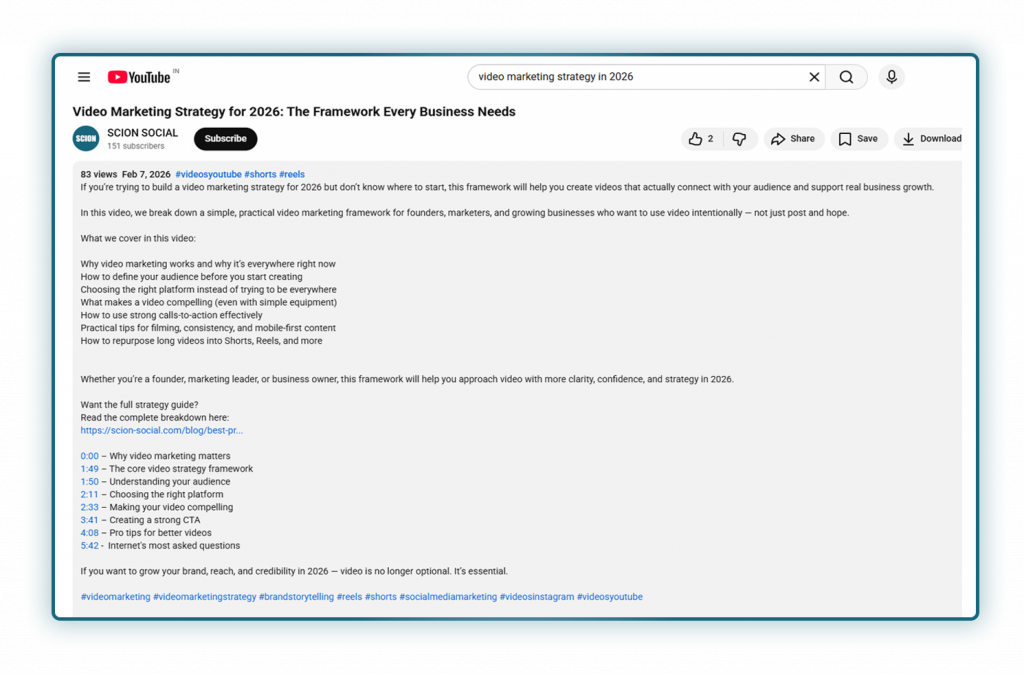
Add Timestamps
Break videos into labeled chapters. Timestamps make it easier for AI systems to locate specific answers, improving extraction accuracy and supporting AI Overviews ranking factors. They also improve viewer experience and engagement, letting viewers jump to the insight they need.
Use Strong Descriptions
Write summaries that clearly explain what the video covers and who it helps. Natural wording improves YouTube ranking signals and supports better understanding by AI systems.
Let’s get into that in more detail.
The Role of Descriptions in 2026
Descriptions now act as context layers for AI systems. They clarify topic intent and reinforce related ideas in natural language.
Instead of listing keywords, explain the subject clearly and reference connected concepts. This supports entity-based SEO, improves YouTube ranking signals, and strengthens your broader video SEO strategy 2026.
Instead of:
“SEO, YouTube SEO, AI SEO, ranking tips.”
Try:
“This video explains how YouTube SEO for AI Overviews improves visibility by using structured content, accurate transcripts, and topic alignment with a broader video SEO strategy 2026.”
Descriptions should guide AI toward understanding expertise, not just list matching terms.
How We’re Pivoting Our Own YouTube SEO
In a search landscape that’s changing quickly, theory only goes so far. The strategies that work best are those that have been tested, refined, and proven through real-world experimentation.
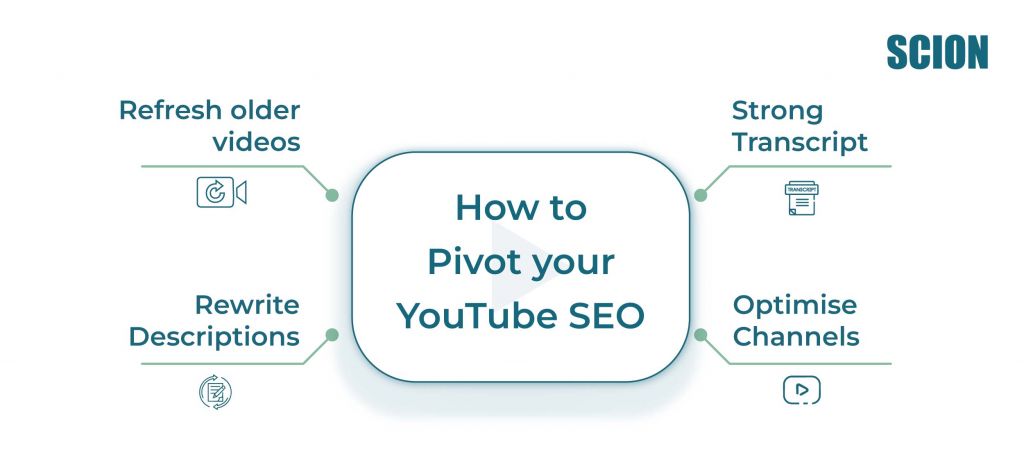
Here’s what we’ve been doing:
Refreshing Older Videos for Clarity
We’re revisiting existing videos to improve structure, tighten messaging, and make insights easier to extract. We’re updating titles, redesigning thumbnails, and refining intros so viewers – and AI – understand the value immediately. This supports stronger YouTube ranking signals.
Rewriting Descriptions With Real Context
We’re updating every description so it clearly explains the topic, audience, and outcome. This helps AI interpret our expertise and supports AI-driven search optimization across our content.
Cleaning Transcripts for Search Accuracy
We’re editing captions to improve readability and precision. Strong transcripts improve video indexing, support YouTube transcript optimization, and make spoken expertise searchable.
Aligning Messaging Across Channels
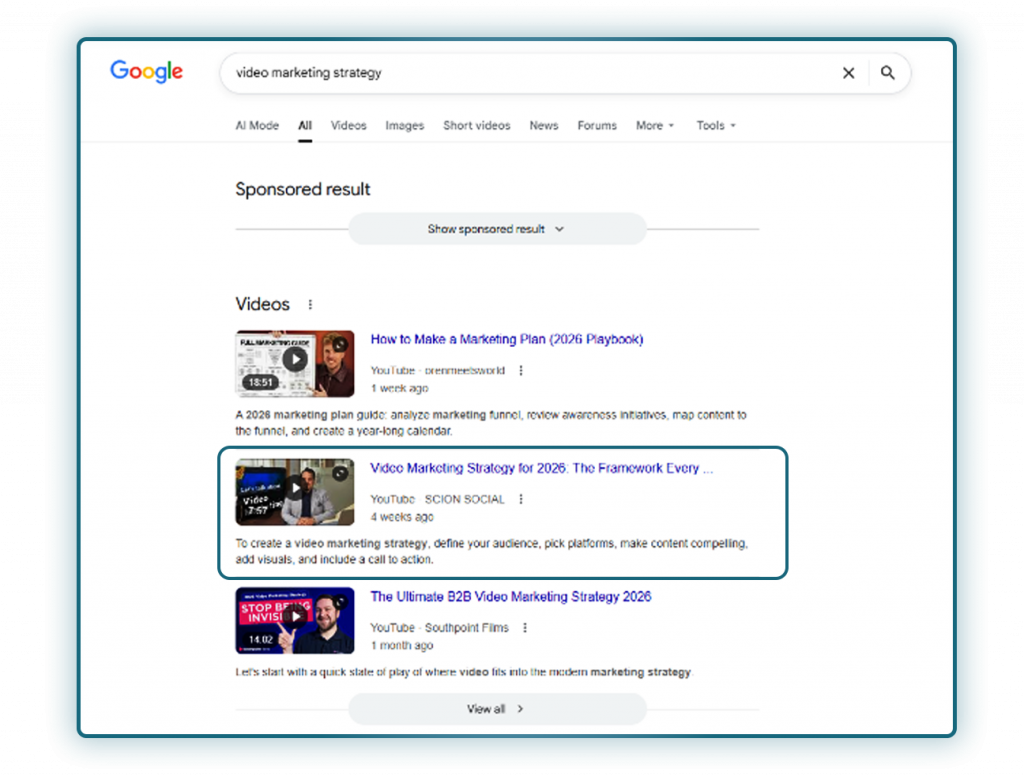
We’re connecting videos to blog clusters and organizing playlists while optimising channels for clear topical authority. This strengthens entity-based SEO, improves Google ecosystem signals, and ensures consistent expertise across platforms.
This isn’t theory. It’s real testing inside our own video SEO strategy.
Take a look at the example below.
The Future of SEO Is Multi-Format Authority
A blog-only strategy isn’t just outdated – it’s risky. When AI systems decide which brands to trust, they look for clear proof of expertise across multiple formats.
To be seen as an authority today, you’ll need to demonstrate knowledge across channels, strengthen entity-based SEO, and send consistent Google ecosystem signals that your expertise is real.
Video is quickly becoming the clearest way to prove that expertise. It turns ideas into structured, explainable content that people can watch, trust, and share.
When blogs, videos, Shorts, podcasts, and social insights all reinforce each other, they create stronger AI-driven search optimization, clearer authority signals, and better long-term visibility than any single format can deliver.
So, for brands looking to lead in YouTube SEO in 2026, the path is clear: integrate, amplify, and optimize across formats – because AI-driven search optimization rewards comprehensive, visible expertise.
Conclusion: Authority Wins in the Age of AI
The shift from pages to entities is already happening. Today, AI-driven search optimization evaluates expertise across formats, not isolated articles. A blog-only strategy is fragile because it sends incomplete authority signals.
Brands that embrace multi-format authority strengthen entity-based SEO, improve Google ecosystem signals, and increase their chances of appearing in AI Overviews. Video has become a primary knowledge layer, turning expertise into structured, searchable content that builds trust.
For businesses that want to lead in YouTube SEO for AI Overviews, the next steps are clear:
- Audit your existing content footprint
- Align blogs, videos, and other formats around core topics
- Optimize every piece for clarity, consistency, and authority
Brands that act now will not only survive the AI-driven evolution of search – they will dominate it.
Pages may inform, but entities get cited.
Stay Future Ready
Want to stay ahead of AI-driven search and digital strategy shifts? Get #FutureReady digital marketing updates delivered straight to your inbox by hitting the ‘Subscribe’ button on our blog page.
FAQ’s
Yes. YouTube videos can appear in AI Overviews when they provide clear, structured explanations that AI systems can extract from transcripts, descriptions, and metadata. Analysis from SEO tools shows that YouTube is cited up to 30% of the time in Google AI Overviews, far outpacing other domains, making optimized video a strong source for inclusion in AI‑generated answers.
To optimize for AI Overviews, create structured, authoritative content that answers questions directly and consistently across formats.
This means aligning blog posts, videos, and supporting content around the same topic, strengthening entity-based SEO, and ensuring transcripts and descriptions are clear. AI systems prioritize clarity, topical depth, and repeated expertise signals – all central to effective AI-driven search optimization.
There isn’t a single tool that guarantees success, but a combination of keyword research platforms, analytics tools, and AI-powered optimization software yields the best results.
Tools specifically built for YouTube SEO – such as vidIQ, TubeBuddy, and Tubics – help identify high-performing keywords, analyze competitors, and optimize titles, descriptions, and tags. Pairing these with insights from YouTube Studio allows creators to refine their content strategy, producing stronger YouTube SEO in 2026.
To optimize YouTube videos for AI search, structure your content clearly and ensure transcripts and descriptions reinforce the core topic.
Use verbal headings inside videos, include FAQ-style answers, add timestamps, and prioritize YouTube transcript optimization. These steps improve machine readability, strengthen AI search optimization, and increase visibility across both traditional search and AI-generated summaries.
Entrepreneurs should post a mix of storytelling, lessons learned, behind-the-scenes moments, and thought leadership. This LinkedIn content strategy for founders helps build brand visibility for entrepreneurs and nurtures trust and engagement.
Yes. YouTube strengthens overall authority signals, which can improve visibility across search ecosystems.
While it may not directly increase page rankings alone, video supports entity-based SEO, reinforces Google ecosystem signals, and enhances brand credibility. When integrated into a broader video SEO strategy 2026, YouTube becomes a key contributor to long-term authority.
Yes. Google indexes YouTube transcripts and captions to better understand video content.
Accurate transcripts improve video indexing, enhance topic clarity, and support stronger YouTube transcript optimization. Well-structured captions make spoken expertise searchable and easier for AI systems to summarize in AI Overviews.
Yes. Videos appear in AI‑generated search results when they provide clear explanations, structured insights, or step‑by‑step knowledge that helps AI models answer queries with confidence. Research shows that YouTube is cited dramatically more than other video platforms in AI Overviews, making YouTube SEO for AI Overviews a core strategy for visibility in 2026.
